Read the offer as an information purchase
A guide can provide direction, sequence, and explanations, but it does not perform the project for you. Your purchase decision should focus on whether the instruction answers the questions you need answered and whether you can carry out the remaining work.
We have not accessed the complete paid material. We cannot confirm its page count, video length, full component list, technical accuracy, or completeness. Any description of the material on this site is limited to visible seller information and supplied promotional artwork.
That is why “what to check” is more useful than an invented inventory of chapters. Ask about the exact file types, the level of detail in the plans, whether measurements are included, and how technical questions are handled.
What the supplied images show
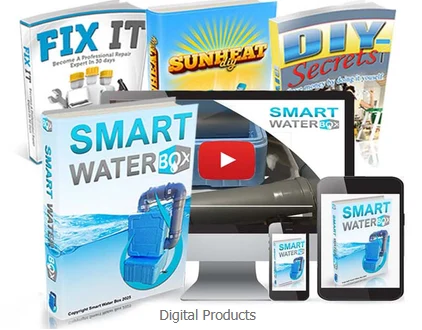
The artwork includes Smart Water Box branding on a guide cover and screens, alongside a device illustration. Another bundle image contains three additional covers. Those visuals are useful for recognizing the offer, but the seller’s order description remains the place to confirm current bundle contents.
Do not interpret a pictured disc as proof that a disc ships to your address, or a pictured tablet as included hardware. Product mockups often illustrate a digital experience. Likewise, a photograph-like device image does not establish construction quality, actual output, or water safety.
Before buying for a gift or for someone with limited internet access, confirm how the person will receive and open the material. Downloadable documents, streamed videos, and account-only access have different practical requirements.
Questions about the instruction itself
- Is there a complete bill of materials with specifications?
- Are measurements and assembly steps included?
- What skill level is assumed?
- Which tasks require qualified help?
- Does the guide explain the cooling and power requirements?
- Does it address cleaning, treatment, testing, and maintenance?
- Are troubleshooting and technical support included?
The answers matter more than the number of pages. A short, precise explanation of a critical component can be more useful than a long promotional introduction. Conversely, a large bundle can still leave essential design details unresolved.
If a sample is available, inspect whether it distinguishes observations from promises. Look for units, diagrams that can be followed, and a clear boundary between general education and product-specific instruction. Our plan-evaluation article gives a structured way to compare those qualities.
Review before sourcing the build
After receiving access, skim the whole guide once before beginning. Identify the required materials, tools, workspace, and any steps that call for professional judgment. Then review the relevant sections in detail and prepare a written list of unresolved questions.
Keep an untouched copy of the original files for your own records if the license and delivery format allow it. Record the date and version if one is supplied. Do not redistribute paid material or post full pages publicly to ask for help.
Make a go-or-no-go decision before buying components. If the requirements conflict with your available space, intended use, or budget, stop at that checkpoint and review the seller’s refund terms. Buying a guide does not oblige you to complete a project.
Create a contents inventory after access
Start with the actual files or pages supplied for your order. List each item, its format, title and version information if available. Compare that inventory with the order description you saved. This is a simple way to distinguish a missing item from a feature that appeared only in promotional artwork or an older offer.
For a video collection, note whether there is an index or a clear sequence. For written material, look for the contents page and the relationship between diagrams and instructions. Do not assume that several files are several independent guides; they may be chapters, supporting documents or alternate formats. The seller should be able to clarify the intended structure.
Keep the original files unchanged in a private copy where the terms permit downloading. Put your notes in a separate document so you can tell the seller's wording from your own interpretation. This matters when asking about a specification or comparing a later revision with the material originally supplied.
Follow one instruction from start to finish
Choose a central step that you can review without carrying out the build. Identify the component, required specification, stated purpose and connection to the next step. Check whether the relevant diagram uses the same name and whether the parts list identifies the same item. This method reveals how usable the documentation is without assigning a vague quality score.
If the instruction says to attach a part but leaves dimensions or compatibility unclear, write down the exact uncertainty. Do not assume an ordinary-looking component is interchangeable with every similar one. If the text refers to a professional task, identify the required expertise before treating it as a beginner activity.
A clear document can still describe a design that needs independent assessment. The review here concerns whether the information can be followed and questioned coherently. It does not establish engineering suitability or drinking-water safety. Those are separate judgments that cannot be inferred from attractive formatting or a confident tone.
Check consistency between written and video material
Different formats can explain the same step well, but they can also come from different revisions. Compare component names, sequence and configuration across the material you receive. If the video shows a different part from the written list, ask whether it is an approved variant, an older example or an error.
Record the location of the discrepancy: page, section title or video time. A precise question is easier to answer than a general statement that the instructions are confusing. Keep any reply with the relevant material and ask whether an updated document is available when the answer changes a step.
Do not quietly assemble a personal hybrid from whichever version seems easier. Combining parts of different arrangements can create a configuration that neither set of instructions describes. If the materials do not establish which version controls, resolve that question before ordering components or proceeding with a build.
Look for a complete operating description
Assembly is only one part of a useful guide. Look for the intended starting condition, normal operation, shutdown, storage between uses and the responsibilities that continue after construction. Identify the inputs needed for a full cycle rather than only the stage shown in a demonstration.
Ask how the design is meant to be inspected and maintained, which replacements are specified and what conditions require stopping or seeking help. These details should come from the actual instructions and qualified advice where necessary. A buyer should not have to infer them from a product mockup.
We have not inspected the paid Smart Water Box material, so we do not claim that these sections are present or absent. They are review questions. Use the requirements page to organize unresolved details and the plans-evaluation article to keep documentation quality separate from performance validation.
If the information format fits your needs, inspect the seller’s current offer and terms before deciding.
View Current OfferEvaluate examples according to their stated purpose
An example can teach a calculation without describing a real product result. A demonstration can illustrate a process without establishing dependable daily output. A photograph can show an assembly without proving the suitability of every material. Look for labels that make these purposes clear.
For a reported measurement, ask which configuration was used, when the observation occurred, how long it ran and how quantities were recorded. For a hypothetical calculation, ask whether the inputs are explicitly identified as assumptions. For a general scientific explanation, ask whether the connection to the proposed design is established or merely suggested.
This prevents a reader from converting educational material into a stronger promise than it makes. It also helps identify claims that need support. If a guide presents a broad result without a method or conditions, record the missing evidence rather than filling it with a favorable interpretation.
Review the role of any bonus material
Bonuses can be useful if they match your interests, but evaluate them separately from the central guide. Confirm that the current order includes the specific items you want. The supplied bundle artwork is not a guarantee that every depicted item remains part of every later promotion.
Ask what each bonus actually contributes. It may cover a different project, provide general background or explain a related topic. Do not assume it supplies a missing technical requirement in the main instructions unless the relationship is explicitly described. A larger bundle does not automatically make the central design more complete or better supported.
Keep your decision focused on the main deliverable. If you would not buy the guide without the bonuses, identify why the additional material changes the value to you. That is a personal educational-value judgment, not evidence of the water project's output, cost savings or suitability for drinking-water use.
Understand access rights and technical compatibility
Read the actual access terms for your order. Determine whether the files can be downloaded, whether access depends on an account and whether any time limit is stated. Do not assume lifetime access, unlimited updates or a physical shipment when those promises are not in the transaction description.
Check the formats with the devices and software you intend to use. A promotional image of a tablet does not establish compatibility with every tablet or accessibility tool. If a particular need matters to you, such as captions, printable instructions or an offline copy, ask whether it is supported rather than assuming it from the artwork.
If access fails, describe the problem specifically: missing message, sign-in issue, unavailable file or unsupported format. Use the seller's verified support route and retain the order reference. The access page explains the distinction between delivery support and technical questions about the actual project.
Decide what you can responsibly do next
After reviewing the material, write a short conclusion with three parts: what is clear, what remains unresolved and what decision the available information supports. For example, you may understand the proposed process but still lack a specification needed to budget a component. That is a reason to seek clarification before the next commitment.
A guide can meet your educational interest while the build remains unsuitable for your circumstances. Conversely, a familiar concept does not mean the instructions are unnecessary if they contain details you still need to evaluate. Judge the material from what it actually provides and the role you want it to serve.
Do not use time already spent reading as a reason to rush into construction. The review is useful precisely because it can change your decision. Keep any refund question tied to the applicable order terms, and keep separately purchased parts and services outside assumptions about a digital-product refund.
A practical reading order for a new buyer
Read the contents and requirements before following an assembly sequence. Then review the complete operating description and the evidence behind any important performance claim. Finally, return to the detailed steps with a question log. This order can prevent someone from buying parts before discovering a later requirement that changes the whole project.
Set aside a separate pass for costs. Use the actual parts and services identified by the material, not a generic budget from another build. Set aside another pass for intended use and appropriate assessment. These reviews answer different questions and should not be replaced by the excitement of seeing the first illustration.
This publication's role is to help you make those distinctions. It has not independently scored the paid Smart Water Box guide, confirmed its full contents or reproduced its project. The purchase remains an information decision made from the seller's current offer and your own needs.
Keep your own notes visibly separate
Use a separate note document for questions, interpretations and possible changes. Label each entry with the source page or video time. This helps avoid remembering your own suggestion as an instruction supplied by the seller. It also lets support see the original wording when you request clarification.
If a later reply resolves a question, retain both the question and answer. State whether the reply clarifies the existing text or changes the proposed procedure. Those are different outcomes. A clarification may help you read the original correctly, while a change may require an updated version or further review. Keeping that distinction visible is useful documentation; it is not evidence that we have found any particular defect in Smart Water Box's paid files.
Questions, answered.
Have you read the complete paid guide?
No. This site evaluates publicly available information and clearly identifies details that require confirmation.
Are the pictured bonuses guaranteed?
Confirm the current bundle at checkout. Promotional artwork alone does not establish the contents of a particular transaction.